Clinical headline: The best contraceptive is the most effective method that is medically safe, acceptable to the patient and realistically compatible with how they live.
Learning objectives
- Conduct a safe, person-centred contraceptive consultation.
- Apply the UK Medical Eligibility Criteria (UKMEC).
- Compare the effectiveness, benefits and risks of available methods.
- Start or switch methods safely and manage incorrect use.
- Provide emergency contraception and appropriate safety-netting.
1. The contraceptive consultation
Clarify reproductive intentions, preferences about hormones and bleeding, ability to use a method consistently, need for STI protection, feelings about procedures and desired non-contraceptive benefits.
History: last menstrual period, cycle regularity, recent unprotected intercourse, current contraception, pregnancy and ectopic history, postpartum or post-abortion status, migraine with aura, hypertension, thrombosis, cardiovascular disease, smoking, BMI, breast or liver disease, diabetes complications, medicines, STI risk, safeguarding and future pregnancy plans.
Assessment: check blood pressure before combined hormonal contraception; record weight/BMI where relevant; perform pregnancy testing when pregnancy cannot be excluded; perform a pelvic examination for intrauterine insertion—not routinely for pills, implant or injection. Offer STI testing according to risk without unnecessarily delaying contraception.
2. UKMEC: the safety framework
| Category | Clinical meaning |
|---|
| UKMEC 1 | No restriction on use. |
|---|
| UKMEC 2 | Advantages generally outweigh theoretical or proven risks. |
|---|
| UKMEC 3 | Risks usually outweigh advantages; expert judgement and/or specialist referral is required. |
|---|
| UKMEC 4 | Unacceptable health risk—do not use the method. |
|---|
Use the current UKMEC 2025 recommendations and consider interacting risk factors rather than treating each condition in isolation.
3. Effectiveness in typical use
| Method | Typical-use effectiveness | Key feature |
|---|
| Implant | Over 99% | No user failure after insertion |
|---|
| Hormonal IUS | Over 99% | Often reduces bleeding |
|---|
| Copper IUD | Over 99% | Hormone-free; also emergency contraception |
|---|
| Injection | About 94% | Late injections reduce effectiveness |
|---|
| Combined pill, patch or ring | About 91% | Requires correct ongoing use |
|---|
| Progestogen-only pill | About 91% | Daily administration |
|---|
| External condom | About 82% | Also reduces STI transmission |
|---|
| Fertility-awareness methods | About 76% | Requires training and consistent monitoring |
|---|
Only condoms protect against most STIs. Dual protection may therefore be appropriate.
4. Long-acting reversible contraception
Copper IUD
Hormone-free, immediately effective and unaffected by BMI or enzyme-inducing medicines. Devices last 5 or 10 years depending on type. Fertility returns promptly after removal. It may make periods heavier, longer or more painful and requires an insertion procedure.
Levonorgestrel intrauterine system
Over 99% effective and often makes periods lighter, shorter and less painful. A 52 mg LNG-IUD is licensed for contraception for up to 8 years. When used for endometrial protection with oestrogen HRT, replace after 5 years.
Etonogestrel implant
Highly effective, rapidly reversible and suitable for many people unable to use oestrogen. Unpredictable bleeding is common. Enzyme-inducing drugs may reduce effectiveness. Follow the current UK licence and local protocol for replacement timing.
DMPA injection
Usually administered every 13 weeks and unaffected by enzyme induction. It may cause irregular bleeding, weight gain, delayed return to fertility and reversible loss of bone mineral density; review benefits and risks regularly.
5. Combined hormonal contraception
The combined pill, patch and vaginal ring contain oestrogen plus a progestogen. They suppress ovulation and may make bleeding predictable, lighter and less painful. They may improve acne, dysmenorrhoea, endometriosis and premenstrual symptoms; there is no medical need for a monthly withdrawal bleed.
Oestrogen increases venous and arterial thrombotic risk. Avoid or seek specialist advice with previous DVT/PE, thrombophilia, migraine with aura, significant hypertension, stroke or ischaemic heart disease, current breast cancer, severe liver disease, major surgery with prolonged immobility, smoking from age 35 or multiple cardiovascular risks.
Starting: cycle days 1–5 usually provides immediate protection; after day 5, use condoms or abstain for 7 days. If pregnancy cannot be excluded, appropriate methods may be quick-started after assessment, with a pregnancy test 21 days after the last unprotected intercourse.
6. Progestogen-only pills
| Type | Considered missed when |
|---|
| Traditional POP | More than 3 hours late |
|---|
| Desogestrel POP | More than 12 hours late |
|---|
| Drospirenone POP | More than 24 hours late |
|---|
POPs contain no oestrogen, can be used during breastfeeding and are suitable for many people with cardiovascular or thrombotic risk. Irregular bleeding is common and all POPs may be less effective with enzyme-inducing medication. Drospirenone requires additional consideration in renal impairment or hyperkalaemia risk.
7. Barrier, behavioural and permanent methods
Condoms: use from the beginning of genital contact. After breakage or slippage, assess emergency contraception and STI testing.
Diaphragm or cap: requires correct fitting and use with spermicide.
Fertility awareness: requires formal training, regular cycles and reliable monitoring of fertility indicators; it is less suitable when pregnancy would present substantial clinical risk.
Sterilisation: intended to be permanent. Discuss highly effective reversible alternatives. Vasectomy is generally simpler and safer than female sterilisation, but contraception must continue until semen testing confirms success.
8. Quick starting
- Assess every episode of unprotected intercourse.
- Offer emergency contraception when indicated.
- Obtain a baseline pregnancy test.
- Quick-start a suitable method when the benefit of immediate protection outweighs delay.
- Advise condoms or abstinence until the method becomes effective.
- Repeat the pregnancy test 21 days after the last unprotected intercourse.
Do not generally quick-start an LNG-IUS unless pregnancy can reasonably be excluded.
9. Emergency contraception
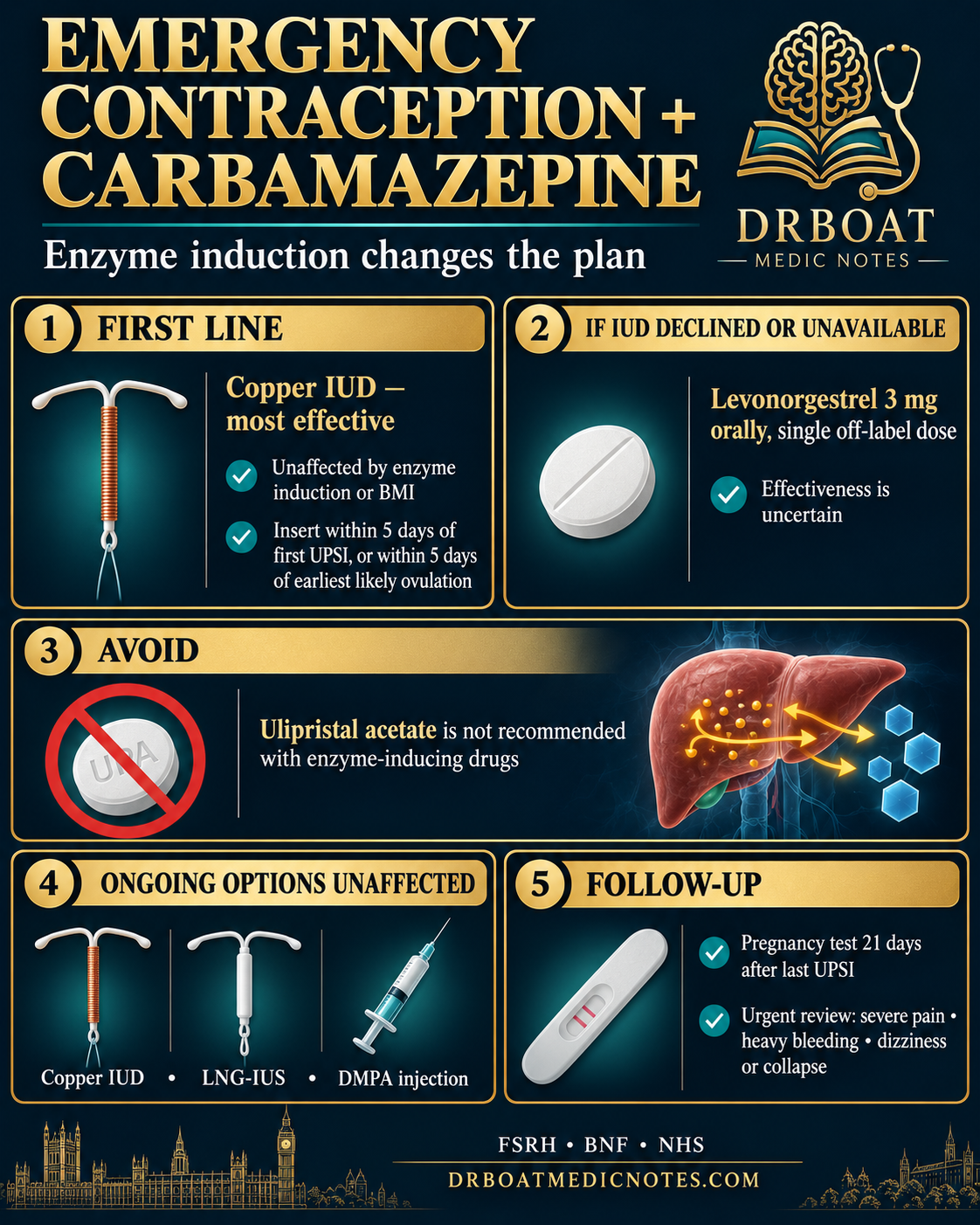
Copper IUD: the most effective option. Insert within 5 days of the first unprotected intercourse in the cycle or within 5 days of the earliest likely ovulation, whichever is later. It also provides ongoing contraception.
Ulipristal acetate: 30 mg orally within 120 hours. Delay progestogen-containing contraception for 5 days afterwards. Do not use with current or recent enzyme-inducing medication.
Levonorgestrel: 1.5 mg orally as soon as possible, licensed within 72 hours. Ongoing hormonal contraception can be started immediately. With enzyme-inducing medication, offer a copper IUD; if declined, consider a single off-label 3 mg dose and explain uncertain efficacy.
Oral emergency contraception mainly delays ovulation and is unlikely to work after ovulation. Arrange a pregnancy test 21 days after the last unprotected intercourse.
10. Drug interactions
Hepatic enzyme inducers—including carbamazepine, phenytoin, phenobarbital, primidone, rifampicin, rifabutin, some antiretroviral medicines and St John’s wort—may reduce the effectiveness of combined hormonal contraception, all POPs, the implant and oral emergency contraception.
Copper IUD, LNG-IUS and DMPA effectiveness is not reduced. Enzyme induction may persist for 28 days after the interacting medicine is stopped.
11. Special situations
Postpartum: contraception is required from day 21 after childbirth unless lactational amenorrhoea criteria are fully met. POPs and implants can start immediately. Combined hormonal contraception is restricted early postpartum because of VTE risk.
Migraine: avoid combined hormonal contraception in migraine with aura. New aura during CHC use requires prompt reassessment.
Hypertension or previous VTE: avoid oestrogen-containing contraception when UKMEC makes it unsafe; consider appropriate progestogen-only or non-hormonal methods.
Current breast cancer: avoid hormonal contraception; a copper IUD is generally preferred.
Over 40: age alone is not a contraindication. CHC may be used until 50 if medically eligible; contraception is usually unnecessary after 55. A 52 mg LNG-IUD inserted at 45 or older can generally remain until 55 for contraception, but not for HRT endometrial protection.
Adolescents: offer the complete range including LARC, assess Fraser competence when under 16, maintain confidentiality and address safeguarding or coercion.
Safety-netting
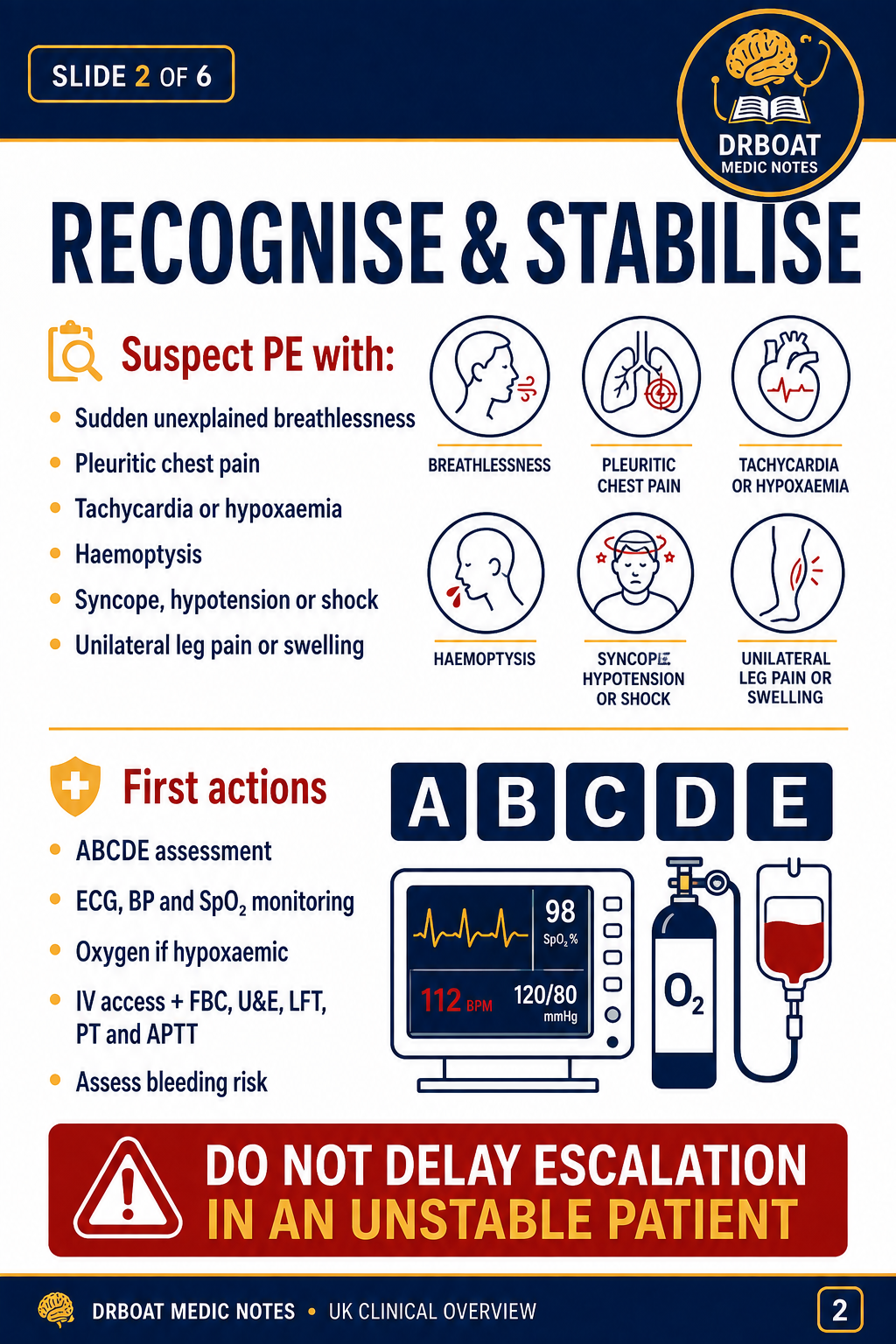
Seek urgent assessment for chest pain or sudden breathlessness; unilateral painful leg swelling; new focal neurological symptoms; severe headache or new aura; severe pelvic pain; heavy bleeding, dizziness or collapse; or a positive pregnancy test with pain or bleeding.
At review, reassess satisfaction, bleeding, adherence, blood pressure for CHC, new diagnoses, new medication interactions, device replacement date and STI needs.
Clinical memory aid: SAFE CHOICE
- S — Sexual and reproductive intention
- A — Assess pregnancy and STI risk
- F — Full medical and medication history
- E — Effectiveness, including typical use
- C — Check UKMEC
- H — Hormonal and non-hormonal options
- O — Offer LARC fairly
- I — Interactions and incorrect use
- C — Counselling and consent
- E — Emergency contraception and safety-netting
UK guidance and further learning
Sources checked 24 October 2026. Educational material; apply current UKMEC, individual assessment, product information and local pathways.