B✚DRBOATMEDIC NOTES

LEARN. UNDERSTAND. SHARE.

Medical knowledge.
Clearly explained.

Visual notes and thoughtful explanations that bring medicine closer to students, healthcare professionals and the communities they serve.

Explore the notes
THE FEATURED NOTE   /   01

Two cancers.
Different warning signs.

Understanding ovarian and cervical cancer.

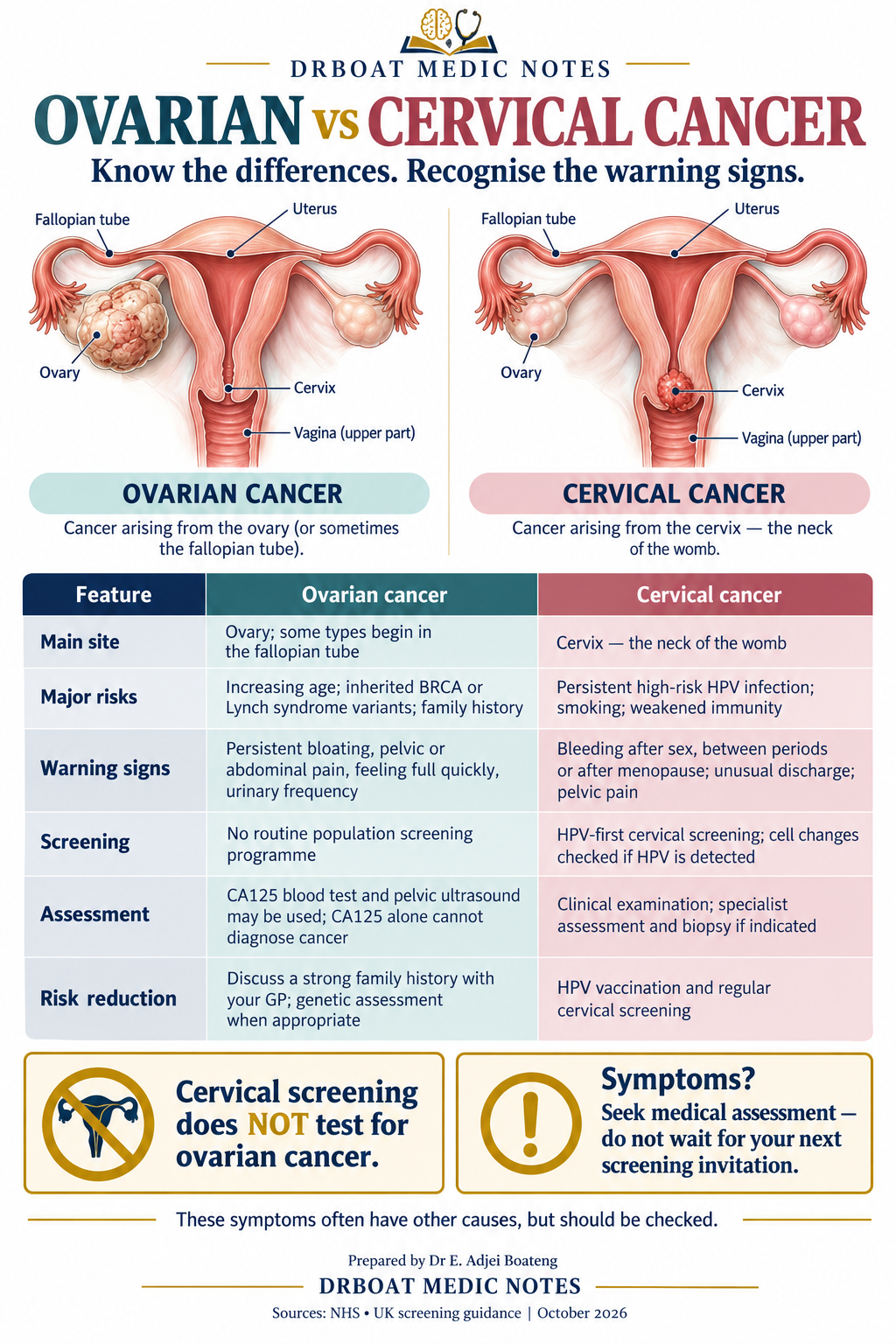
DRBOAT MEDIC NOTES comparison of ovarian and cervical cancer, including warning signs, screening and assessment
OBSTETRICS & GYNAECOLOGYACUTE & EMERGENCY CAREPUBLIC HEALTH & AWARENESS

THE NOTEBOOK

A little clarity goes a long way.

Explore clear explainers and clinical learning notes.
Read, save and return when you need them.

WOMEN’S HEALTH

Ovarian vs
cervical cancer

Know the differences.
Recognise the warning signs.

4 October 2026 · Quick learning note

Download infographicView full-size image
01

Ovarian cancer

Persistent bloating, abdominal or pelvic pain, feeling full quickly and needing to pass urine more often are symptoms worth checking. Risk increases with age, and some inherited gene changes increase risk.

Assessment may include a CA125 blood test and pelvic ultrasound. Further investigations are needed to confirm a diagnosis.

02

Cervical cancer

Nearly all cases are linked to high-risk HPV infection. Warning signs include bleeding after sex, between periods or after menopause, changes in vaginal discharge and pelvic pain.

HPV vaccination and cervical screening help prevent cervical cancer. Screening checks for high-risk HPV first, with cell changes checked if HPV is detected.

Sources & further reading
O&G CLINICAL REASONING · DRILL 6

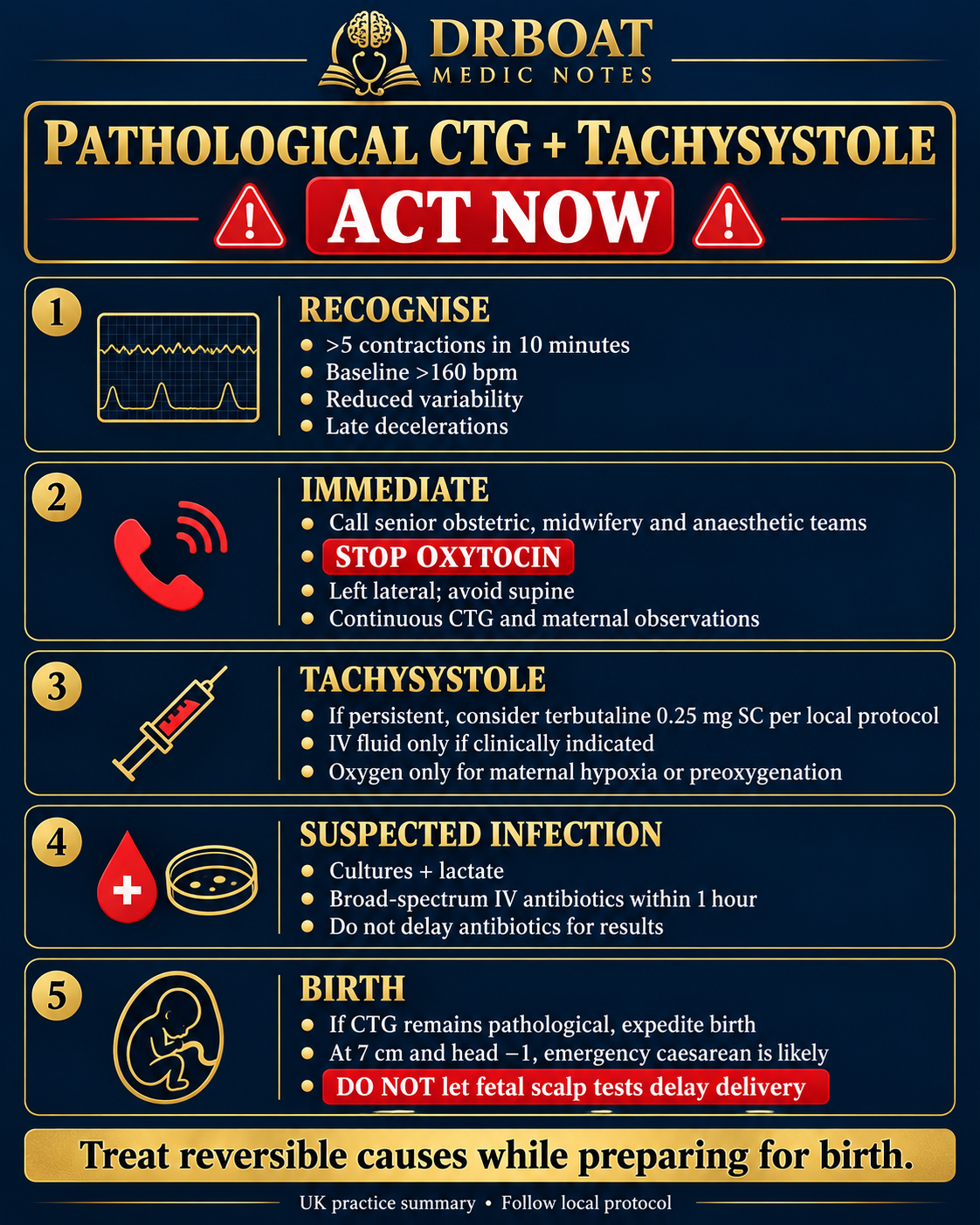
Pathological CTG + tachysystole

Published 3 October 2026 · Physician-level UK practice drill

TIME-CRITICAL

THE SCENARIO

A 30-year-old woman, G1P0 at 39+2 weeks, is undergoing induction of labour for reduced fetal movements. Her membranes ruptured 22 hours ago. She has an epidural and is receiving an oxytocin infusion.

  • Cervix 7 cm; fetal head at −1 station
  • Temperature 38.3°C, HR 122 bpm, BP 108/66 mmHg, RR 22/min
  • Offensive liquor with thick meconium
  • Six contractions in 10 minutes, several lasting longer than 90 seconds

The CTG over 40 minutes shows a baseline of 175 bpm, variability of 3 bpm, recurrent late decelerations with more than half of contractions, and no accelerations.

Answer all sections together
  1. Classify and interpret the CTG.
  2. Identify the likely causes and time-critical features.
  3. Give your immediate actions and investigations.
  4. State the medication, escalation and definitive delivery plan.
  5. Explain whether fetal scalp stimulation or blood sampling has a role.
  6. Include neonatal care, postpartum monitoring and safety-netting.
Reveal the ideal approach

Interpretation

This is a pathological CTG: baseline above 160 bpm and recurrent late decelerations are red features; variability below 5 bpm for 40 minutes is amber. Six contractions in 10 minutes indicate tachysystole. The pattern suggests evolving or established fetal hypoxia.

The likely mechanism is multifactorial: oxytocin-related uterine hyperstimulation plus suspected intra-amniotic infection. Fever, prolonged rupture of membranes, offensive liquor and maternal and fetal tachycardia strongly support infection. Maternal sepsis remains a concern and requires assessment for organ dysfunction.

Immediate actions

  1. Call the senior obstetrician, coordinating midwife, anaesthetist, theatre and neonatal team.
  2. Stop oxytocin immediately.
  3. Place the mother left lateral, continue CTG and complete an ABCDE assessment.
  4. Confirm the trace is fetal, review maternal observations and assess reversible causes.
  5. If tachysystole persists, consider terbutaline 0.25 mg subcutaneously according to local protocol and contraindications.
  6. Start locally recommended broad-spectrum IV antibiotics promptly when infection or sepsis is suspected.

Give IV crystalloid according to haemodynamics, lactate and clinical assessment. Do not give routine oxygen when maternal oxygen saturation is normal; reserve it for maternal hypoxaemia or anaesthetic preoxygenation.

Investigations

Request FBC, CRP, U&E/creatinine, LFTs, coagulation screen, glucose, venous blood gas and lactate. Obtain blood cultures if this does not delay antibiotics, plus group and save, urine output monitoring, urine culture and appropriate genital or placental microbiology.

Birth and aftercare

Do not delay delivery for fetal scalp stimulation or blood sampling. At 7 cm with the head at −1, birth is not imminent and operative vaginal delivery is inappropriate. Correct reversible causes while preparing for emergency caesarean birth; if the CTG does not recover rapidly, this is likely a category 1 caesarean.

After birth, obtain paired cord gases. The neonatal team should assess for hypoxia, meconium exposure and early-onset infection. Continue maternal observations, fluid balance, urine output, lactate and blood-result review; reassess antibiotics against cultures and clinical response.

Memorable learning point: Pathological CTG + tachysystole = stop oxytocin immediately while treating reversible causes and preparing for birth.

Guidance and further reading
PUBLIC HEALTH & AWARENESS

Plague in Russia? What we know

Published 7 October 2026 · Reviewed 7 October 2026

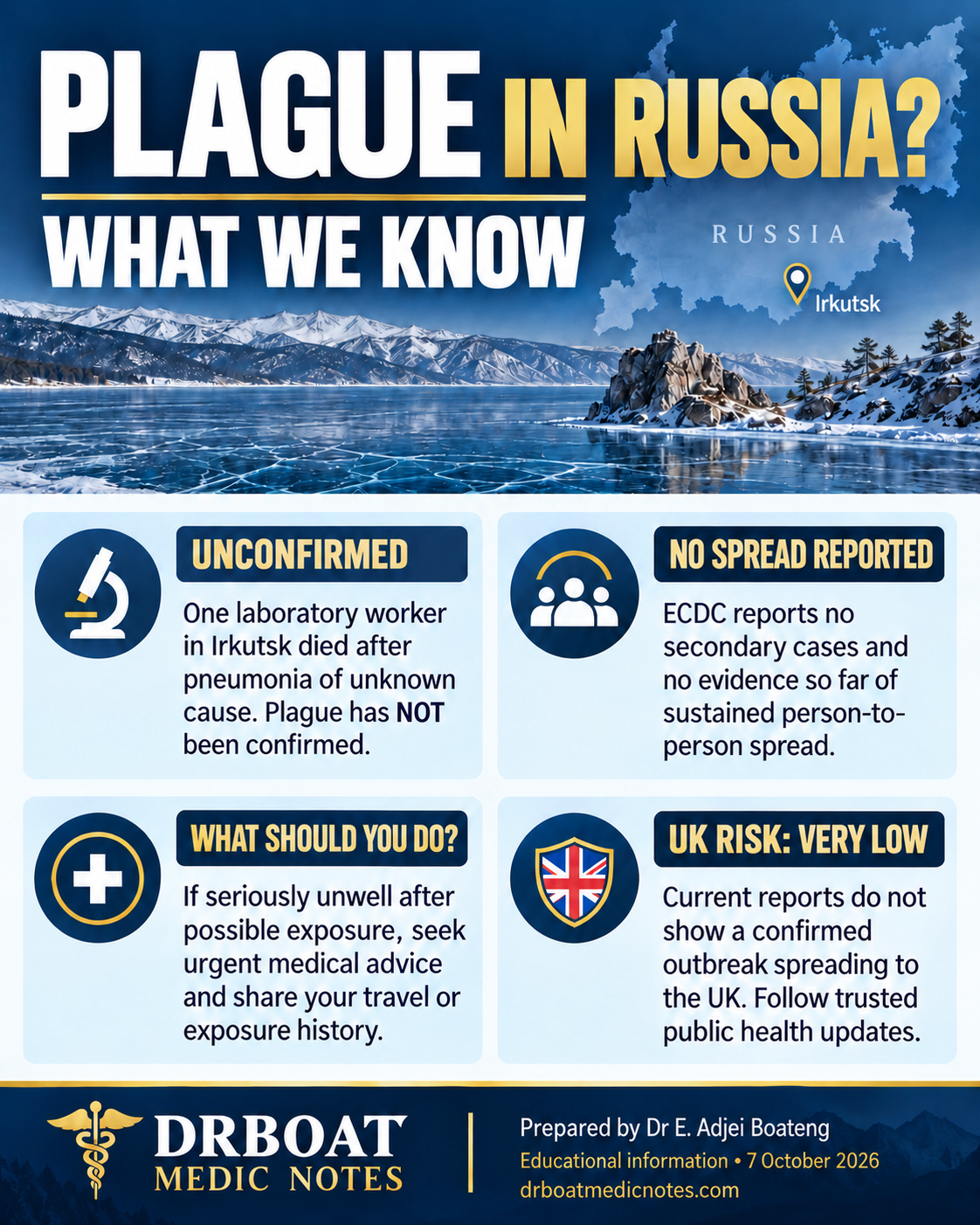
Current status: unconfirmed

A laboratory worker in Irkutsk died after developing pneumonia of unknown cause. Plague has not been confirmed as the cause. The WHO says it does not yet have the full picture and has requested more information. ECDC reported no secondary cases and no evidence of sustained person-to-person transmission in the information available on 6 October 2026.

Public explainer

Plague is a bacterial infection caused by Yersinia pestis. It can spread through infected flea bites or contact with infected animal tissues. Pneumonic plague affects the lungs and can spread through respiratory droplets during close contact.

The current reports do not establish a confirmed plague outbreak in Russia. The ECDC assessed the risk to people in the EU as very low based on the limited information available. Follow reliable public health updates and avoid sharing unverified claims.

If you become seriously unwell after possible exposure in an affected area, seek urgent medical advice and explain your travel and exposure history.

Clinical notes

Recognise: bubonic disease may present with fever and a painful, swollen lymph node; pneumonic disease with rapidly progressive fever, cough and breathlessness; septicaemic disease with severe systemic infection or shock.

If plague is a credible possibility: isolate a patient with suspected pneumonic disease and use appropriate respiratory precautions. Urgently involve local infectious disease and microbiology specialists. In the UK, contact UKHSA’s Imported Fever Service and notify the local Health Protection Team as advised; plague is an urgent notifiable disease in England.

Testing and treatment: coordinate specimen collection and testing through specialist services. Do not delay specialist-directed empirical treatment while awaiting confirmation when clinical suspicion is credible.

These notes support learning; follow current local protocols and specialist advice. They are not a treatment protocol.

Sources & further reading
Dr E. Adjei Boateng in a navy suit and burgundy tie

BEHIND THE NOTES

Dr E.
Adjei Boateng

Medicine. Education. Understanding.

“Making medical knowledge easier to understand, one note at a time.”

DRBOAT MEDIC NOTES is an educational brand created by Dr E. Adjei Boateng, a physician with clinical experience in Ghana and a particular interest in obstetrics and gynaecology.

The notes bring together medical learning and public health awareness, using illustrations and clear explanations to make complex topics more approachable.

For learnersA clear starting point for study and revision.
For communitiesHealth information that starts useful conversations.

KEEP LEARNING

Go to the source.

Use original guidance alongside educational notes.

A note on using these resources

For education and awareness. These notes do not replace individual medical assessment, current clinical guidance or local protocols. If you are concerned about symptoms, contact a healthcare professional.